




What is amalgam filling?

Amalgam can be described as an alloy obtained from the combination of mercury and any metal. Almost all metals, except iron, tantalum, and platinum, can form amalgam when combined with mercury. This substance, especially when mixed with silver and copper, is extremely important in dentistry. In short, the answer to the question "what is amalgam?" is that it is a substance used as a filling material in dentistry.
Contents
- What is a dental filling?
- How are fillers injected?
- What is amalgam filling?
- Is the mercury used in amalgam fillings harmful?
- What are the advantages of amalgam fillings?
- What are the disadvantages of amalgam fillings?
- What are the differences between amalgam fillings and composite fillings?
- Are Amalgam Fillings Durable?
- Should Amalgam Fillings Be Replaced?
- What are the disadvantages of amalgam fillings?
- Fill out the form to get detailed information.
What is a dental filling?
Dental filling In answer to the question "what is it?", we can say that it is the process of restoring teeth that have lost substance due to decay, breakage, or cracking. Dentist, First, the decay in the tooth is removed, creating a cavity. Then, this cavity is filled with filling materials, completing the procedure. The reason for dental fillings is to restore the function of teeth that have lost substance due to various reasons.
How are fillers injected?
Dental filling For treatment, it's primarily necessary to check whether the decay or fracture has reached the nerve. If the decay or fracture hasn't yet reached the nerve, you're lucky. This means the tooth can be saved with a filling. The question of how a tooth filling is done is one of the most frequently asked questions today. Briefly, the decay in the tooth to be filled is first cleaned. Then, saliva and tongue isolation is ensured, and the filling process begins. In this process, the opened cavity is disinfected, the gap in the tooth is filled, and the tooth's appearance is restored.
What is amalgam filling?
Amalgam dolgu nedir sorusuna, çok uzun yıllardır, diş çürüklerinin sebep olduğu boşlukları doldurmak amacıyla kullanılan bir materyallerdir ve halk arasında gümüş dolgu olarak bilinir, diyebiliriz. Amalgam dolgunun genellikle %50’si cıva, geri kalan kısmı da bileşenlerdir. Bu dolgu malzemesinin yaklaşık 150 yıldır aktif olarak kullanıldığı belirtilmektedir. Kolay şekil alması sebebiyle uygulama kolaylığı sağlayan amalgam dolgu aynı zamanda uzun süre dayanıklı ve ekonomiktir. Özellikle derin, sinire yakın çürüklere sahip dişlerin kurtarılmasında son derece etkili olan amalgam dolgunun en büyük dezavantajı metal renginde olmasıdır. Koyu gri renginde olması, ağızda estetik olmayan dolgu çeşidinin özellikle arka tarafta yer alan çiğneme dişi çürüklerinde kullanılması tavsiye edilir. Ayrıca cıva alerjeni hastaların amalgam dolguyu tercih etmemesi hayati önem taşır.
Is the mercury used in amalgam fillings harmful?
Since mercury is a naturally occurring material in the environment, everyone is exposed to it to some degree through air, drinking water, soil, or food. Therefore, some contact with mercury through amalgam is not considered very different from other daily exposures.
As with most substances, the harm caused by mercury in the body depends on the amount ingested. Very low levels of mercury do not cause any side effects. However, at higher levels, mercury is known to cause some adverse effects. As amalgam fillings erode, very small amounts of mercury can vaporize and spread into the mouth, where they can be absorbed by the tongue.
It is perfectly logical to question whether the presence of amalgam in the mouth is dangerous. However, studies have concluded that amalgam fillings pose no cause for concern. This is because the low amount of mercury absorbed is not sufficient to cause any adverse effects. In fact, research has shown that the level of mercury exposure from amalgam fillings is less than what many people are exposed to in their daily lives or through the foods they consume.
What are the advantages of amalgam fillings?
Amalgam fillings are a preferred type of filling due to their harmlessness, long-term use, durability, and affordability. They are particularly common in back teeth because of their ability to withstand chewing forces. The advantages of amalgam fillings are listed below:;
- Long-lasting durability,
- More affordable,
- Quick and easy implementation,
- Effective for use on chewing teeth.
What are the disadvantages of amalgam fillings?
Amalgam fillings, although frequently preferred for many years, are no longer widely used due to recent concerns about their harmful effects. Because they contain a large amount of mercury, they are rarely used today unless absolutely necessary. Amalgam fillings, which combine materials like silver, copper, and tin, create a durable filling material as the mercury binds to the other metal components. The disadvantages of amalgam fillings are as follows:
- An aesthetically unappealing appearance (silver color),
- Sensitivity to hot and cold.,
- Concerns about the mercury it contains,
- Allergic reactions,
- Risk of tooth cracking.
These disadvantages must be considered when choosing amalgam fillings. Your dentist will help you determine the most suitable type of filling for your needs and preferences.
 What are the differences between amalgam fillings and composite fillings?
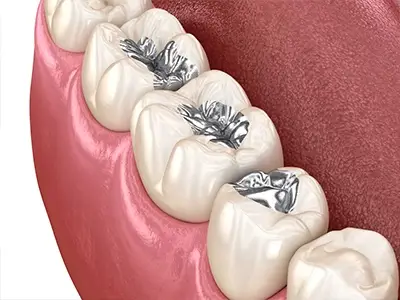 What are the differences between amalgam fillings and composite fillings?
In the past, amalgam fillings were commonly preferred, but since the introduction of resin-based aesthetic materials, their use has significantly decreased. This is especially true for small cavities. composite filling Using amalgam fillings can be considered more advantageous. This is because it causes very little loss of tooth structure. Conversely, amalgam fillings may be preferred for deeper cavities. This is because no corrosive substances like acid are used during the application, and it does not release heat during hardening.
When choosing fillings, factors such as aesthetics, color matching, biocompatibility, thermal conductivity, durability, plaque retention rate, minimal shrinkage during hardening, ease of application, and processing are considered. Filling materials must be compatible with the tooth and surrounding tissues. They should not damage the gums or the tooth pulp. They must be hypoallergenic. For this reason, amalgam can be considered a near-perfect type of filling. It only raises concerns from an aesthetic point of view. It can be preferred for teeth in the posterior regions.
Are Amalgam Fillings Durable?
The most important factor that distinguishes amalgam fillings from other types of fillings is their ability to maintain their durability for a long time. Being a strong material, amalgam fillings can last an average of 10-15 years. Of course, proper and regular oral care, ensuring necessary oral hygiene, and the location of the tooth where the amalgam filling is placed play an important role in maintaining its durability. For example, the lifespan of an amalgam filling may be somewhat shorter in molars where wear is high. However, the use of amalgam fillings has decreased considerably in recent times. Because of its color, amalgam fillings create a decayed appearance in the tooth, and due to aesthetic concerns, they are not preferred; instead, composite fillings, which have a more aesthetic appearance, are preferred.
Should Amalgam Fillings Be Replaced?
The health risks associated with mercury in amalgam fillings can raise concerns for those who use them. Publications about accidentally swallowing amalgam fillings while eating may frighten patients, and some may even want to have them removed. However, because amalgam fillings contain very low doses of mercury, they can be considered relatively safe.
The mercury in amalgam can evaporate during chewing and enter the body through inhalation, but the amount is at a micro level. Thousands of studies and research have been conducted worldwide on amalgam fillings. The U.S. Food and Drug Administration (FDA), maintaining an unbiased perspective, has deemed amalgam fillings safe for children over 6 years old and adult patients. Studies conducted by the FDA on individuals with amalgam fillings have proven that mercury levels in their bodies are not at levels harmful to health. Furthermore, removing an amalgam filling is a very difficult procedure and can damage the tooth supporting the filling and neighboring teeth. If your amalgam filling is fine, not causing an allergic reaction, and not causing pain, having it removed out of fear of it being dangerous is not a good idea.
What are the disadvantages of amalgam fillings?
Although amalgam fillings are effective in terms of durability, their use has become less frequent in recent years due to the harmful effects of mercury, which is a major component of their composition. Other materials used in the filling include silver, copper, and tin.
Mercury is a material that is liquid at room temperature. It binds other metals used in fillings, creating a strong filling material. However, research has shown that mercury, even in fillings, has negative effects on human health. Harmful effects of mercury can spread to internal organs, negatively impacting the heart, liver, lungs, kidneys, nervous system, and immune system. Furthermore, mercury poisoning can occur in individuals allergic to mercury due to amalgam fillings. Of course, as mentioned above, there are also studies that claim the opposite.