




What is a Digital Imaging Technique (Intraoral Scanner)?
Digital impression is the process of scanning the inside of a patient's mouth in three dimensions using an intraoral scanner and transferring the scan to a computer, without the use of classic impression materials (alginate, silicone, etc.).
In other words, a 3D digital model of the teeth, gums, and all surrounding tissues is created. Instead of a physical measurement, entirely digital data is obtained.
This system is part of CAD-CAM technology.
- CAD (Computer Aided Design) = Computer-aided design
- CAM (Computer Aided Manufacturing) = Computer-aided production
Contents

How does an intraoral scanner work?
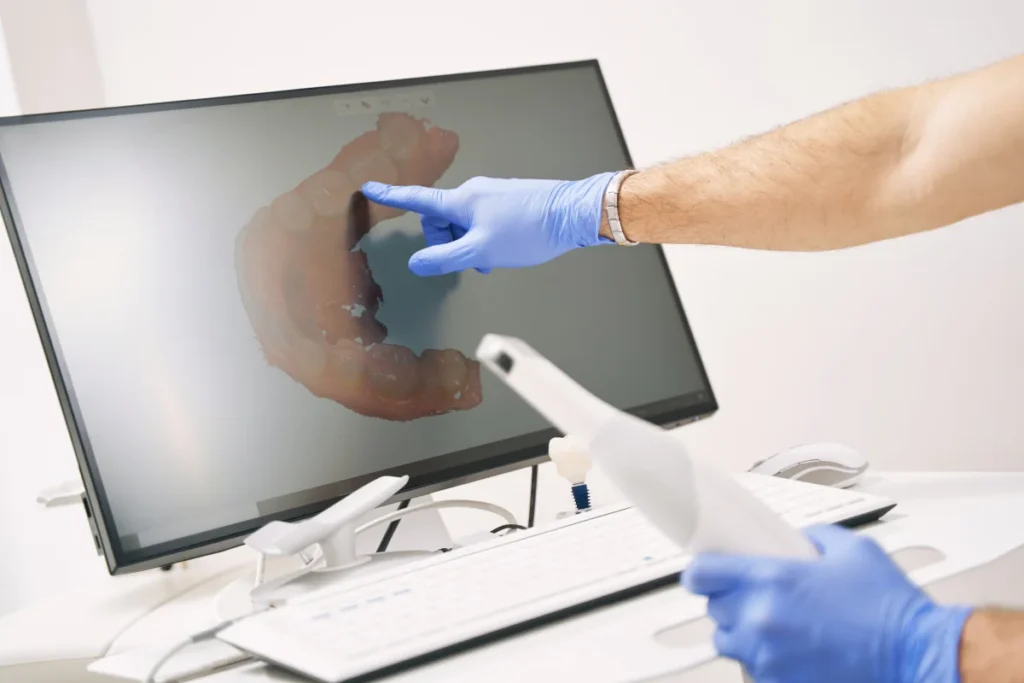
The pen-shaped scanner tip is inserted into the patient's mouth.
Device =
- It emits a laser or structured light.
- It detects reflected light using sensors.
- It records thousands of images in a very short time.
- By combining these images, it creates a 3D model.
The screen displays a real-time 3D image of the teeth. If there are any missing or incorrect areas, that region can be rescanned. This provides a significant advantage in terms of verification.

In what situations are digital measurements used?
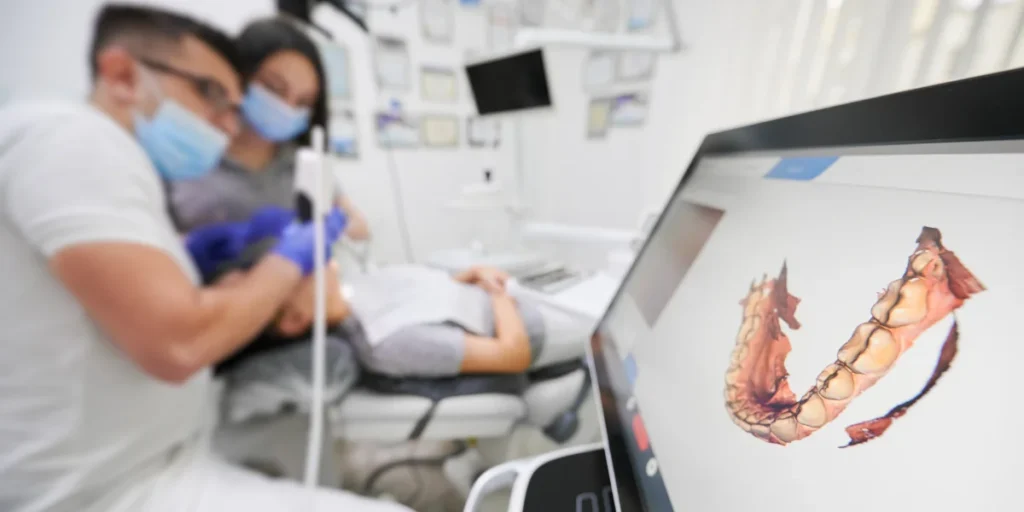
• During the impression-taking stage after preparation in crown and bridge applications.
• For implant-supported prostheses, digital recordings are taken using a scan body attached to the implant.
• For clear aligner planning and fixed orthodontics in orthodontic treatments.
• In laminate, zirconium and porcelain restorations
• In the production of night guards and splints
What are the advantages of digital measurement?
- We can say this in the area of patient comfort.
- No measuring spoon is used.
- The nausea reflex is triggered less often.
- There is no waiting period for silicone implants in the mouth. This provides significant relief, especially for patients with a gag reflex.
- We achieve more accurate results; there is no risk of the impression material shrinking or tearing.
- Instantaneous monitoring is possible.
- The erroneous area is corrected immediately.
- We save time. The process is completed in a few minutes.
- No physical measurements are sent to the laboratory.
- The digital file is transmitted instantly.
- No disinfection is required for the measuring instrument.
- Finally, the measurements are stored electronically, and if necessary, the old record can be reopened without taking new measurements.
Digital measurement also affects the clinical process.
- Preparation is done.
- Retraction is applied.
- The area is isolated and dried.
- The area is scanned using the scanner.
- A recording of the opposite jaw is taken.
- An occlusion record is created.
- The file is sent digitally to the lab.
Digital Measurement Prices
Digital impression prices may vary depending on the type of treatment, the systems used, and the type of restoration. For detailed treatment and pricing information, you can visit or call İnci Diş.
Digital measurement of the implant.
A scan body is placed on the implant.
The scanner uses this part as a reference to locate the implant:
- Your position
- Its angle
- Its depth
It perceives and translates it into a digital model.
This can be much more comfortable than the classic open tray size.
CAD-CAM Process
After scanning:
- Cron is designed on the computer.
- Zirconium block or ceramic block is selected.
- It is milled on a milling machine.
- Sintering and glazing processes are performed.
The most commonly used intraoral scanners
- 3Shape TRIOS
- ITERO
- Medit
- CEREC Primescan
- Carestream
How is a 3D model technically created?
Scanner:
- It analyzes how light hits a surface and bounces back.
- Calculates distance using the triangulation principle.
- It collects data from thousands of points (point cloud).
- It converts this data into a surface mesh.
The resulting files are usually in STL or PLY format.
What is an STL file?
STL is a file format used for three-dimensional modeling. Manufacturing equipment can read this format and create restorations.
What is a PLY file?
A PLY file is a file type used for saving three-dimensional models. It is a frequently used format, especially in systems that perform 3D scanning.